
Blog
The Most Valuable AI Skills to Learn in 2026

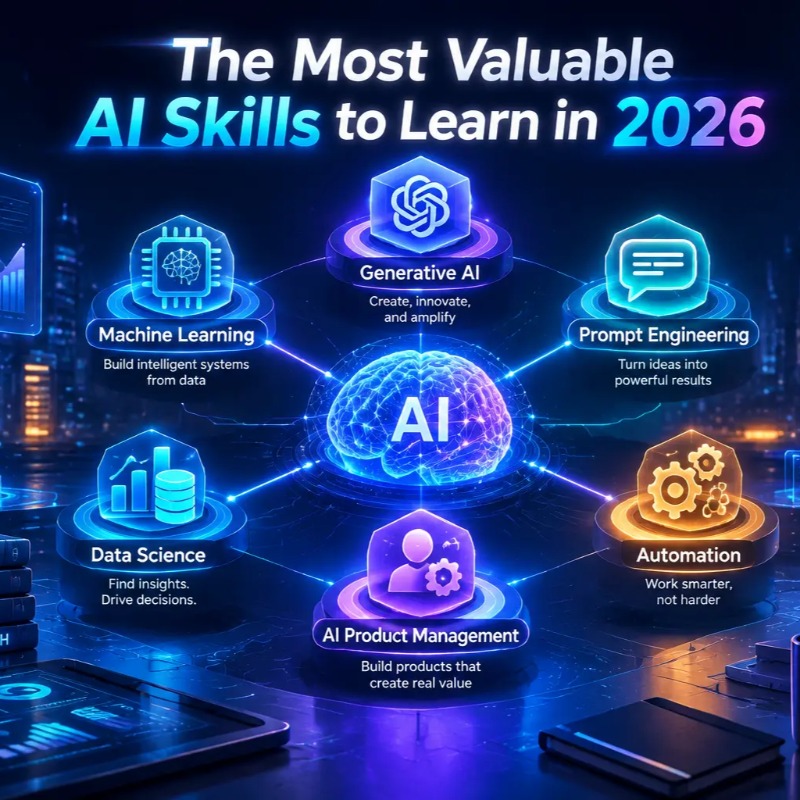
Artificial intelligence is no longer a technology limited to research laboratories or large technology companies.
In 2026, AI has become part of everyday professional workflows. Developers use AI to write and analyze code. Marketers use it to research audiences and optimize campaigns. Designers use AI-assisted tools to explore ideas. Businesses use artificial intelligence to automate repetitive tasks and analyze information.
But as AI becomes easier to access, an important question is emerging:
Which skills should people actually learn to remain valuable in an AI-driven economy?
The answer is not simply “learn how to use ChatGPT.”
The most valuable professionals are likely to be those who understand how to combine AI tools with domain knowledge, critical thinking, creativity, communication, and practical problem-solving.
AI Is Changing the Meaning of Professional Skills
For many years, professional expertise was closely connected to the ability to perform specific tasks manually.
A marketer might spend hours researching keywords, preparing reports, writing advertising copy, and analyzing campaign data.
A developer might spend hours writing repetitive code, debugging errors, and preparing documentation.
AI can now assist with many of these activities.
This does not necessarily mean that these professions are disappearing.
Instead, the value of individual skills is changing.
The World Economic Forum has highlighted software developers as an early example of how AI is reshaping knowledge work, with developers increasingly moving toward higher-level problem-solving, architecture, integration, and AI-enabled decision-making.
The same pattern is appearing across other industries.
Routine execution is becoming easier to automate.
Strategic thinking is becoming more valuable.
AI Fluency Is Becoming a Basic Professional Skill
One of the first skills professionals should develop is basic AI fluency.
This means understanding:
- What AI systems can do
- What they cannot reliably do
- How to communicate instructions effectively
- How to evaluate AI-generated output
- How to protect sensitive information
- How to incorporate AI into existing workflows
AI fluency is different from simply knowing how to open an AI chatbot.
Someone can use an AI tool every day without actually becoming more productive.
The real skill is knowing when to use AI, how to use it, and how to verify the result.
According to the American Marketing Association’s 2026 research, AI fluency has become a baseline expectation in marketing, while skills such as strategic thinking, adaptability, quality control, and original thinking remain especially important.
1. Prompting and AI Communication
One of the most accessible AI skills is the ability to communicate effectively with AI systems.
A vague instruction often produces a generic result.
A well-structured instruction can provide much more useful output.
Effective AI communication involves understanding:
- Context
- Objectives
- Constraints
- Desired output
- Examples
- Audience
- Evaluation criteria
For example, instead of asking an AI system:
“Write a marketing article.”
A professional might specify the target audience, purpose, tone, structure, keywords, length, evidence requirements, and desired call to action.
This makes the AI workflow much more predictable.
However, prompting should not be viewed as a magic trick.
The quality of the result depends heavily on the user’s understanding of the problem.
Someone who understands marketing can usually provide much better instructions for a marketing task than someone who only knows how to write prompts.
2. AI-Assisted Content and Marketing
Marketing is one of the fields being significantly transformed by AI.
AI can assist with:
- Market research
- Content ideas
- Copywriting
- Campaign planning
- Customer segmentation
- Data analysis
- Advertising
- Search optimization
- Personalization
Gartner reported in 2026 that marketing organizations are rapidly adopting AI, while skills gaps remain one of the major obstacles preventing companies from turning experimentation into consistent business value.
This creates an important distinction.
The future marketer does not necessarily need to compete with AI at producing text faster.
Instead, the marketer needs to understand the customer, define the strategy, interpret data, and use AI to execute parts of that strategy more efficiently.
3. AI and Search Optimization
Search is another area where AI is changing established workflows.
Traditional SEO remains important, but marketers increasingly need to understand AI-powered search and generative search experiences.
This creates demand for skills related to:
- AI SEO
- Search intent
- Content optimization
- Technical SEO
- Generative Engine Optimization
- Content strategy
- Search analytics
The key skill is not simply knowing how to generate an article.
It is understanding how people search, how search systems interpret information, and how useful content can become visible across different search experiences.
Professionals who combine traditional SEO knowledge with AI tools can potentially analyze larger amounts of information and develop content strategies more efficiently.
4. AI-Assisted Software Development
Programming is another field experiencing a major transformation.
AI coding tools can help developers generate code, explain existing code, identify bugs, create tests, and work with large codebases.
This means developers can spend less time on repetitive implementation and more time on architecture and problem-solving.
But learning AI-assisted development still requires programming fundamentals.
A developer who cannot understand the generated code may struggle to identify security issues, incorrect assumptions, performance problems, or architectural weaknesses.
The future developer therefore needs two things:
Technical knowledge + AI fluency.
Neither one completely replaces the other.
5. Data Literacy
AI becomes much more useful when professionals can understand data.
Data literacy means being able to interpret information, recognize patterns, question assumptions, and make decisions based on evidence.
Professionals do not necessarily need to become data scientists.
But they should understand basic concepts such as:
- Metrics
- Trends
- Correlation
- Data quality
- Visualization
- Experimentation
- Performance measurement
AI can summarize a dataset, but the professional still needs to determine whether the conclusion makes sense.
This is why critical thinking and data literacy remain important even as AI tools become more sophisticated.
6. Automation and Workflow Design
Another valuable skill is understanding how individual AI tools can be connected into workflows.
Instead of using AI for isolated tasks, professionals can design repeatable systems.
For example:
Research → AI analysis → Content creation → Human review → Publishing → Performance analysis
Or:
Customer request → AI classification → Data retrieval → Draft response → Human approval
Workflow design requires understanding both the business process and the technology.
The goal is not to automate everything.
The goal is to identify repetitive processes where automation can create measurable value.
7. Critical Thinking and Quality Control
As AI-generated information becomes more common, the ability to evaluate output becomes increasingly important.
AI systems can produce incorrect information with a convincing tone.
They can misunderstand context.
They can make assumptions.
They can also produce technically correct information that is inappropriate for a particular situation.
This is why quality control is becoming a valuable professional skill.
A good AI workflow should include verification.
The question should not simply be:
“Can AI generate this?”
It should be:
“How do I know the result is correct and useful?”
8. Creativity and Original Thinking
AI can generate ideas quickly.
But generating ideas and having meaningful ideas are not the same thing.
Professionals still need to understand audiences, culture, emotions, markets, products, and human behavior.
Creativity becomes especially valuable when AI can produce hundreds of generic alternatives within seconds.
The advantage may go to the person who can recognize the one idea that actually matters.
This is why original thinking should be developed alongside technical AI skills.
9. Adaptability
Perhaps the most important skill of all is adaptability.
AI tools change quickly.
A tool that is popular today may be replaced or transformed within months.
Learning a specific interface is therefore less valuable than learning how to learn.
Professionals should become comfortable with:
- Experimenting with new tools
- Testing different workflows
- Learning from mistakes
- Evaluating new technologies
- Updating existing processes
The ability to adapt can remain valuable even when individual technologies change.
AI Skills Are Becoming More Valuable Across Industries
The growth of AI-related skills is not limited to technology companies.
PwC’s 2026 Global AI Jobs Barometer, which analyzed more than one billion job advertisements across six continents, found that jobs requiring specific AI skills were growing substantially faster than the overall jobs market. The report also found a significant wage premium associated with AI skills.
At the same time, AI is not simply creating demand for people who build AI systems.
Many organizations need professionals who can apply AI inside existing roles.
This could mean an AI-enabled marketer, developer, analyst, designer, salesperson, project manager, or business owner.
The opportunity is therefore much broader than becoming an AI engineer.

What Should Someone Learn First?
For someone starting from scratch, the number of available AI tools can be overwhelming.
A practical learning path can begin with five areas:
Start With AI Fundamentals
Learn how modern AI systems work at a high level and understand their strengths and limitations.
Learn to Work With AI
Practice giving clear instructions, providing context, evaluating results, and iterating on outputs.
Apply AI to a Real Skill
Instead of learning AI in isolation, connect it to something useful.
This could be:
- SEO
- Marketing
- Programming
- Design
- Data analysis
- Business
- Content creation
Build Projects
Projects provide a way to turn theoretical knowledge into practical experience.
Rather than simply watching tutorials, build something.
Develop Human Skills
Communication, critical thinking, creativity, decision-making, and adaptability remain essential.
AI does not remove the need for these skills.
In many cases, it makes them more valuable.
Why Structured Learning Can Make a Difference
The internet contains an enormous amount of free information about artificial intelligence.
The problem is not access to information.
The problem is knowing what to learn, in what order, and how to apply it.
A structured learning platform can help learners move from basic concepts to practical applications without having to assemble an entire curriculum themselves.
For people interested in developing practical skills across AI, SEO, web development, and other digital disciplines, Webox Academy offers courses and educational resources focused on modern digital workflows.
The advantage of a structured approach is that learners can focus on developing useful skills rather than simply collecting information about new tools.
The Future Belongs to AI-Augmented Professionals
The most important question is not whether AI will replace a particular profession.
A better question is:
How will AI change what professionals in that field do?
Developers are already using AI to accelerate software development.
Marketers are using it to analyze data and automate workflows.
Content teams are using it for research and production.
Businesses are using it to improve productivity and decision-making.
The professionals who benefit most may be those who learn to work alongside AI rather than treating it as either a threat or a magical solution.
Final Thoughts
Artificial intelligence is changing the skills people need to succeed.
AI fluency, prompting, automation, data literacy, SEO, software development, critical thinking, creativity, and adaptability are becoming increasingly interconnected.
But learning dozens of tools is not the goal.
The real goal is to become capable of solving real problems with modern technology.
AI can make execution faster.
Human expertise determines what should be done.
The combination is what creates value.
For professionals, students, freelancers, entrepreneurs, and anyone preparing for the future of digital work, investing in practical AI skills today can be a powerful way to stay adaptable as technology continues to evolve.